
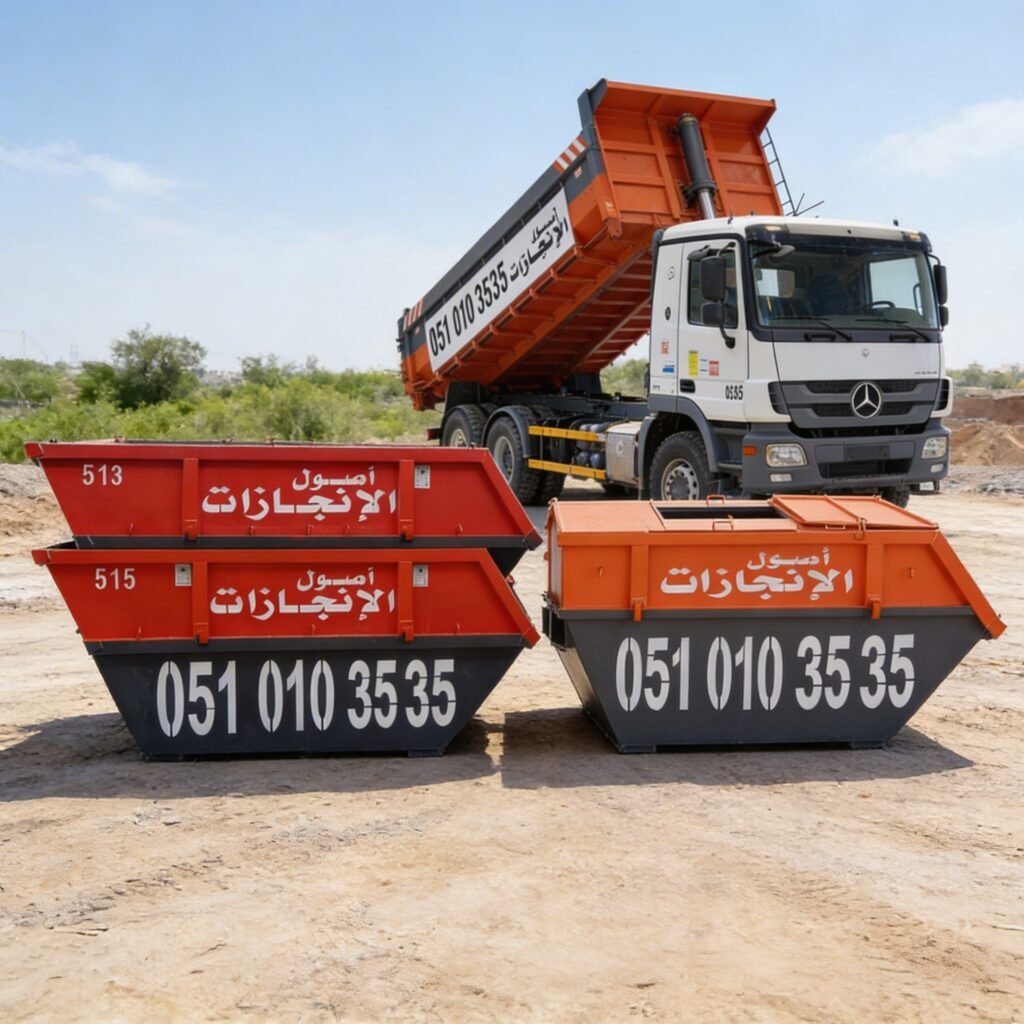
Planning a home renovation in Riyadh? Here’s how to handle your waste efficiently
A complete, district-aware guide to managing renovation debris in the Saudi capital — from estimating volume to staying compliant with Riyadh Municipality.
In this article
- Why renovation waste planning matters more in Riyadh than you’d think
- The regulatory backdrop: who is watching, and what they’re watching for
- Types of waste your renovation will generate
- Step-by-step: managing your renovation waste from start to finish
- Typical waste volumes by renovation type
- Choosing a waste container or skip provider in Riyadh
- What happens to your waste after collection
- Common mistakes Riyadh homeowners make
- Frequently asked questions
Riyadh’s residential landscape is being remade at a pace few cities anywhere in the world can match. From villa refurbishments in Al Malqa and Al Yasmin to apartment fit-outs near King Abdullah Financial District, homeowners across the capital are investing heavily in upgrading their spaces — new kitchens, modernised bathrooms, open-plan living areas, and smart-home retrofits. Behind every one of these projects sits a less glamorous but equally important question: what happens to everything that gets ripped out?
This guide walks through, in detail, exactly how to manage renovation waste in Riyadh — from the moment you start planning through to final disposal — so that your project stays compliant, your neighbours stay unaffected, and your budget doesn’t quietly leak away on avoidable waste costs.
Why renovation waste planning matters more in Riyadh than you’d think
It’s easy to treat waste disposal as an afterthought — something to deal with once the dust has settled. In Riyadh specifically, that approach carries more risk than homeowners often realise. The city’s rapid residential growth has placed real pressure on municipal waste infrastructure, and Amanat Al-Riyadh (Riyadh Municipality) has correspondingly tightened enforcement around unauthorised dumping, unlicensed skip placement on public roads, and unpermitted debris storage in residential neighbourhoods.
Beyond the regulatory angle, Riyadh’s climate and urban density add practical considerations that don’t apply everywhere. Dust from demolition debris affects air quality more noticeably in a desert climate, sharp materials left on residential streets pose a genuine hazard in family-dense neighbourhoods, and debris blocking drainage channels becomes a serious problem during the city’s occasional but intense rainfall events.
“In Riyadh, renovation waste that isn’t planned for doesn’t just cost money — it becomes the neighbour dispute, the fine, and the delay that derails an otherwise smooth project.”
The regulatory backdrop: who is watching, and what they’re watching for
Three layers of oversight typically apply to a Riyadh home renovation project, even a modest one. Amanat Al-Riyadh governs construction and demolition waste at the municipal level, including permits for skip placement on or near public roads and enforcement against illegal dumping within city limits. The National Centre for Waste Management (Mwan) licenses the waste contractors who are legally permitted to collect, transport, and dispose of construction debris — using an unlicensed operator, even unknowingly, can leave the homeowner exposed to liability. The Ministry of Municipal, Rural Affairs and Housing sets the broader national framework that Amanat Al-Riyadh enforces locally.
For a typical homeowner-led renovation, this translates into a few practical requirements: confirming your waste contractor holds a valid Mwan licence, obtaining a municipal permit if a skip will sit on a public road or shared access area, and avoiding any storage of debris that blocks pavements, neighbours’ access, or drainage points for extended periods.
Types of waste your renovation will generate
Understanding what you’re dealing with shapes every decision that follows — from container size to disposal route. Most Riyadh home renovations produce a predictable mix of waste categories.
- Inert waste — broken tiles, concrete, plaster, sand, and masonry rubble, typically the largest volume category by far
- Bulky waste — old kitchen units, doors, windows, bathroom fixtures, and furniture being replaced
- Hazardous waste — paint tins, solvents, adhesives, and old electrical fittings, which require separate, licensed handling
- Metal waste — pipework, wiring, and structural offcuts, which often have resale value if kept clean and separated
- General waste — packaging from new materials, food waste from on-site workers, and miscellaneous site rubbish
Step-by-step: managing your renovation waste from start to finish
Step 1
Estimate your waste volume
Walk the space before work starts and estimate cubic metres of debris, based on the scope of demolition involved.
Step 2
Segregate from day one
Set up separate areas or bins for rubble, metal, hazardous items, and general waste before demolition begins.
Step 3
Book a licensed container
Reserve a skip or container sized to your estimate, from a provider holding a verified Mwan licence.
Step 4
Check placement permits
If the skip will sit on a public road or shared driveway, confirm whether a municipal placement permit is required.
Step 5
Request disposal documentation
Ask your contractor for a waste transfer note or disposal certificate once collection is complete — keep it on file.
Step 6
Recover what you can
Set aside intact tiles, fixtures, or metal offcuts for resale, donation, or recycling rather than disposal.
Typical waste volumes by renovation type
These figures are general estimates intended to guide your initial container booking — your actual volume will vary based on the depth of demolition involved.
Bathroom renovation
2–4 m³
Kitchen renovation
3–6 m³
Single bedroom refresh
1–3 m³
Apartment-wide renovation
8–15 m³
Full villa renovation
20–40 m³
Majlis or extension build
10–18 m³
Choosing a waste container or skip provider in Riyadh
Riyadh’s residential renovation market is well served by waste management providers, but the quality and compliance posture of operators varies considerably. Before booking, it is worth confirming a few specific points: a current Mwan licence number that you can independently verify, proof of liability insurance, a clear quote that distinguishes between container hire and disposal fees, and a stated maximum fill level with overflow charges disclosed up front rather than discovered on the invoice.
It’s also worth asking directly whether the provider segregates loads for recycling or sends everything to landfill as mixed waste — providers who actively route clean material to recycling facilities are increasingly common in Riyadh and often charge comparably to those who don’t.
Placing an unpermitted skip on a public road in residential areas of Riyadh — particularly in tighter villa compounds in districts like Al Nakheel or Al Sahafa — is one of the most common sources of municipal fines for homeowners. Confirm placement rules with your provider or Amanat Al-Riyadh before the container arrives.
Where renovation activity is concentrated across Riyadh
Al Malqa
High villa renovation volume, new developments nearby
Al Yasmin
Mixed villa and townhouse upgrades
Al Nakheel
Established neighbourhood, tighter street access
Al Sahafa
Apartment and villa renovation mix
Diplomatic Quarter
Stricter access and placement requirements
Hittin
Newer villas, larger-scale renovation projects
What happens to your waste after collection
In a well-managed renovation, segregated inert waste is taken to a licensed sorting or crushing facility, where concrete and masonry are processed into recycled aggregate used in road base and fill applications. Clean metal is sold into the scrap market and re-enters the steel supply chain. Hazardous items go to specialist treatment facilities licensed by Mwan. What cannot be recovered is disposed of at an approved landfill, with documentation issued at each stage. This entire chain depends on your waste being properly segregated before it ever leaves your home — mixed loads are far more likely to bypass recycling and go straight to landfill.
Common mistakes Riyadh homeowners make
A handful of avoidable errors account for the majority of renovation waste problems homeowners encounter in Riyadh. Underestimating volume leads to overflow charges or a second container booking mid-project. Skipping the licence check on a waste contractor — often because a neighbour or contractor recommended someone informally — can leave the homeowner liable if waste is dumped illegally. Leaving a skip unsealed and overflowing onto the street invites both fines and complaints from neighbours. And discarding intact fixtures, tiles, or fittings that could have been resold or donated adds unnecessary volume and cost for no real benefit.
Frequently asked questions
Do I need a permit to place a skip outside my home in Riyadh?
If the skip will sit on a public road, shared driveway, or any space outside your private property boundary, you typically need authorisation from Amanat Al-Riyadh or must place it through a licensed provider who manages this on your behalf. Requirements can vary by district, so confirm with your provider before delivery.
How long can I keep a waste container on-site during a renovation?
This depends on your agreement with the provider and any municipal permit conditions attached to the placement. Most residential renovation containers are booked for periods ranging from a few days to several weeks, with collection scheduled around fill level rather than a fixed calendar date in many cases.
What should I do with leftover paint, solvents, or chemicals after my renovation?
These are classified as hazardous waste and should never go into a general skip or household bin. Ask your waste contractor whether they handle hazardous materials directly, or request a referral to a Mwan-licensed hazardous waste handler for safe collection and disposal.
Can renovation waste be recycled in Riyadh, or does it all go to landfill?
A significant portion can be recycled, particularly concrete, masonry, and clean metal — but only if it is kept segregated and the waste contractor actually routes it to a recycling or processing facility rather than a landfill. Ask your provider directly about their recycling practices before booking.