
Same-day container delivery in Riyadh: what to expect and how to prepare
How same-day skip delivery actually works in the Saudi capital, what can delay it, and everything you need to have ready before the truck arrives.
In this article
- Is same-day delivery genuinely available in Riyadh?
- How same-day container delivery works in practice
- What affects delivery timing in Riyadh
- How to prepare your site before the container arrives
- District-specific access considerations
- What to check when the container is delivered
- After delivery: keeping the process on track
- Frequently asked questions
A burst pipe behind a newly tiled wall. A contractor who showed up early and tore out more than expected. A landlord insisting on a site clearance before the next tenant moves in tomorrow. In Riyadh’s fast-moving renovation and construction market, the need for a waste container today — not next week — is more common than most people plan for.
The good news is that same-day container delivery is genuinely available from a number of waste management providers operating across the Saudi capital. The less obvious news is that “available” and “guaranteed” are not the same thing, and whether a same-day delivery goes smoothly depends almost entirely on how well you prepare before the truck leaves the depot. This guide covers everything that affects timing, what to have ready, and how to avoid the common pitfalls that turn a same-day booking into a next-day delivery.
“Same-day container delivery in Riyadh is available — but it rewards the customer who has thought through access, placement, and permit requirements before picking up the phone.”
Is same-day delivery genuinely available in Riyadh?
Yes — a number of licensed waste management providers operating across Riyadh’s residential and commercial districts offer same-day delivery as a standard or premium service option. The practical window for same-day delivery is typically a morning booking confirmed before 10:00–11:00 AM for afternoon delivery, though some providers with larger fleets and broader district coverage can accommodate bookings made into the early afternoon for late-day placement.
Availability varies by district, container size, and time of year. Periods of peak construction activity — particularly the cooler months from October through March, when outdoor work accelerates significantly across Riyadh — can reduce same-day availability as fleets become heavily committed. If your project is time-sensitive, calling to confirm availability before assuming it exists is always the right first step.
It is also worth noting that same-day delivery does not automatically mean same-day placement permit approval from Amanat Al-Riyadh or Balady. If your container will sit on a public road, the permit process runs on the municipality’s timeline — not the provider’s. A provider who routinely handles same-day residential deliveries in Riyadh will know this and should guide you accordingly.
How same-day container delivery works in practice
Understanding the operational sequence helps set realistic expectations about what “same-day” actually means in practice.
Morning — as early as possible
Booking confirmation
Contact the provider, confirm same-day availability for your district and container size, provide your exact site address, and clarify placement location. The earlier the call, the wider the delivery window available to you.
After booking confirmation
Permit and logistics check
Provider checks truck availability, assigns your delivery to a route, and — if the container will sit on a public road — flags the permit requirement. Confirm explicitly who handles this step and whether same-day permit processing is feasible for your district.
Before the truck departs
Site readiness check
Your responsibility: clear the placement area, remove any vehicles or obstructions, confirm the ground surface can support the container, and ensure access for the delivery vehicle from the road to the intended spot.
Delivery window
Container drop-off
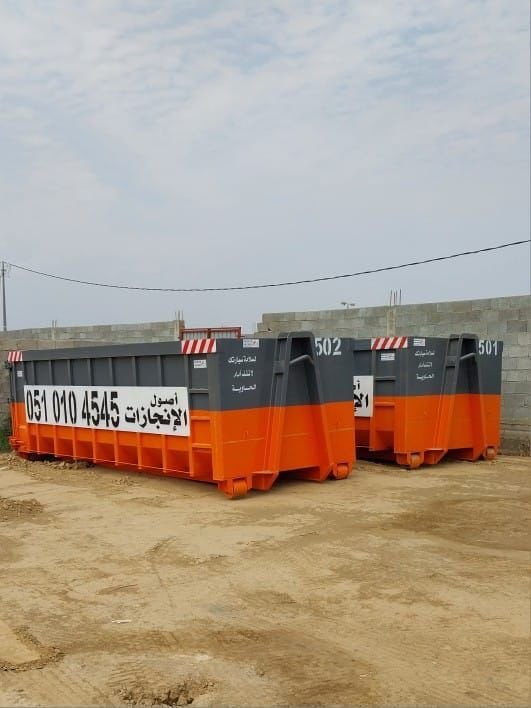
The delivery vehicle arrives within the agreed window. The driver will place the container using a hook-lift or skip-loader system. The process typically takes 10–20 minutes including approach, placement, and departure.
At delivery
Confirmation and documentation
Confirm the container is placed in the agreed position, check for visible damage, and ensure you have the provider’s collection contact number and the reference for any placement permit that was obtained.
What affects delivery timing in Riyadh
Several factors specific to Riyadh’s urban environment can affect whether a same-day delivery lands on time, or at all.
Traffic and road conditions
Riyadh’s arterial roads — particularly King Fahd Road, King Abdullah Road, and the ring roads — carry significant heavy vehicle traffic during daytime hours. Delivery trucks serving residential districts frequently navigate narrower secondary streets where congestion, parking encroachment, and construction activity can add meaningful time to a route. Providers with good local knowledge will factor this into delivery windows; those without may give optimistic estimates that don’t survive contact with Riyadh’s road reality.
Fleet availability and district coverage
Not every provider has a delivery truck positioned near every district at the moment of booking. A provider with a fleet depot in the eastern residential zones may offer faster same-day delivery to districts like Al Malqa, Hittin, and Al Yasmin than to southern areas near Al Shifa or Al Diriyah — and vice versa. When booking for same-day delivery, asking where the provider’s nearest depot is relative to your location gives a more honest indication of realistic timing than any general promise of “within four hours.”
Prayer times and working hours
In Saudi Arabia, operations slow or pause during prayer times. This is a normal and predictable feature of the working day in Riyadh — not a complication — but it affects delivery windows in ways that are easy to overlook when planning a tight same-day schedule. A delivery booked to arrive just before Asr, for example, may arrive just after instead. Factor 20–30 minutes of buffer around each prayer window when planning time-sensitive deliveries.
Container size and availability
The smallest and most common container sizes are the most likely to be available for same-day delivery. Large roll-on/roll-off containers — typically used for full villa or commercial fit-out projects — are fewer in number and may require advance booking even when smaller skips are readily available. If your project needs a large container and timing is tight, booking the day before is a substantially more reliable approach than relying on same-day availability.
Riyadh district delivery notes
Al Malqa, Hittin, Al Yasmin, Al Nakheel: Generally good road access, established waste provider coverage. Compound gates and boom barriers in gated developments can delay access if not pre-arranged with security.
Al Sahafa, Izdihar, Al Rawdah: Mixed street widths — confirm the delivery truck dimensions against your access road width before booking, particularly for larger containers.
Diplomatic Quarter: Strict vehicle access controls; coordinate with estate management in advance, as same-day access cannot be assumed even for smaller skips.
Rapidly developing northern corridors (Neom-adjacent districts, Al Qirawan, Al Arid): Active construction on surrounding roads can create unpredictable access delays — build extra buffer into same-day delivery expectations.
How to prepare your site before the container arrives
Clear the placement area of vehicles
The delivery truck needs an unobstructed approach and at least the container’s footprint plus clearance on all sides clear of parked cars.
Measure your access width
Confirm the delivery truck can physically enter your street or compound. For tight residential lanes, ask the provider for their truck width in advance.
Check the ground surface
Containers should not be placed on unstable, sloped, or soft ground. Confirm the surface is level and load-bearing before the truck arrives.
Notify compound or building security
In gated communities and managed buildings, a delivery truck arriving unannounced can be turned away at the gate. Give security advance notice of the arrival.
Ensure someone is on-site
The driver will need to confirm placement location with a site contact. An unmanned site can result in a failed delivery and a re-delivery fee.
Have your segregation zones planned
Decide where you’ll position bins for different waste types before the container arrives, so work can begin immediately after placement.
What to check when the container is delivered
The moment of delivery is the right time to verify a few things that are much harder to resolve later. Check that the container is the size and type you ordered — dimensions on-site occasionally differ from what was described over the phone, particularly for less common container types. Inspect the container for existing damage, holes, or structural issues that could affect its integrity or create liability for you if damage is attributed to your site after collection. Confirm the fill-level marking is visible on the container and that you know where it is — overfilling above this line is typically subject to a surcharge. Finally, take a photo of the container in position immediately after placement: this documents the placement location, condition, and date, and protects you if any dispute arises about damage or permit compliance later.
If the delivered container is placed in a position different from what was agreed — particularly if it now obstructs a neighbour’s access, a pavement, or a drainage point — address this with the driver at delivery rather than after the truck has left. Repositioning after the fact typically incurs a charge and requires a new placement assessment.
After delivery: keeping the process on track
Once the container is on-site, a few simple practices keep the rest of the process running smoothly. Keep the container covered or managed to prevent wind-blown debris from leaving the site — this is both a neighbourly consideration and a compliance requirement in residential areas of Riyadh. Fill it progressively rather than all at once, which helps with weight distribution and makes it easier to estimate when a collection call is needed. Schedule collection proactively before the container is absolutely full, rather than calling when it is already overflowing — most providers can accommodate a next-day collection with sufficient notice, but same-day collection is less reliably available than same-day delivery in most Riyadh districts.
Frequently asked questions
What is the latest I can call to still get same-day delivery in Riyadh?
This varies by provider and district, but as a general rule, bookings made before 10:00–11:00 AM have the best chance of securing same-day delivery within normal working hours. Some providers with larger fleets can accommodate early-afternoon bookings for late-day delivery, but this should always be confirmed verbally rather than assumed.
Can same-day delivery be guaranteed, or is it always subject to availability?
No provider can guarantee same-day delivery absolutely — fleet availability, traffic conditions, and district access variables all affect whether it can be fulfilled on a given day. What a good provider can offer is an honest assessment of feasibility at the time of booking and a commitment to a specific delivery window rather than a vague “today” promise. If same-day delivery is critical to your project, have a backup provider in mind.
Will the provider help me with the placement permit if I need the container on a public road today?
Same-day Balady or Amanat Al-Riyadh permit processing is generally not feasible — the municipal review process operates on its own timeline. If your project is urgent and the container must sit on a public road, discuss this honestly with the provider at booking; they may be able to place the container within private property temporarily, or advise on the most practical approach given your specific situation and district.
What happens if the delivery truck cannot access my street?
If the truck cannot complete the delivery due to access issues that were not disclosed at booking — a gate that won’t open, a street too narrow for the vehicle, an obstruction that wasn’t cleared — most providers will charge a failed delivery or re-delivery fee. Confirming access in advance, as described in the preparation section above, is the most effective way to avoid this outcome.