
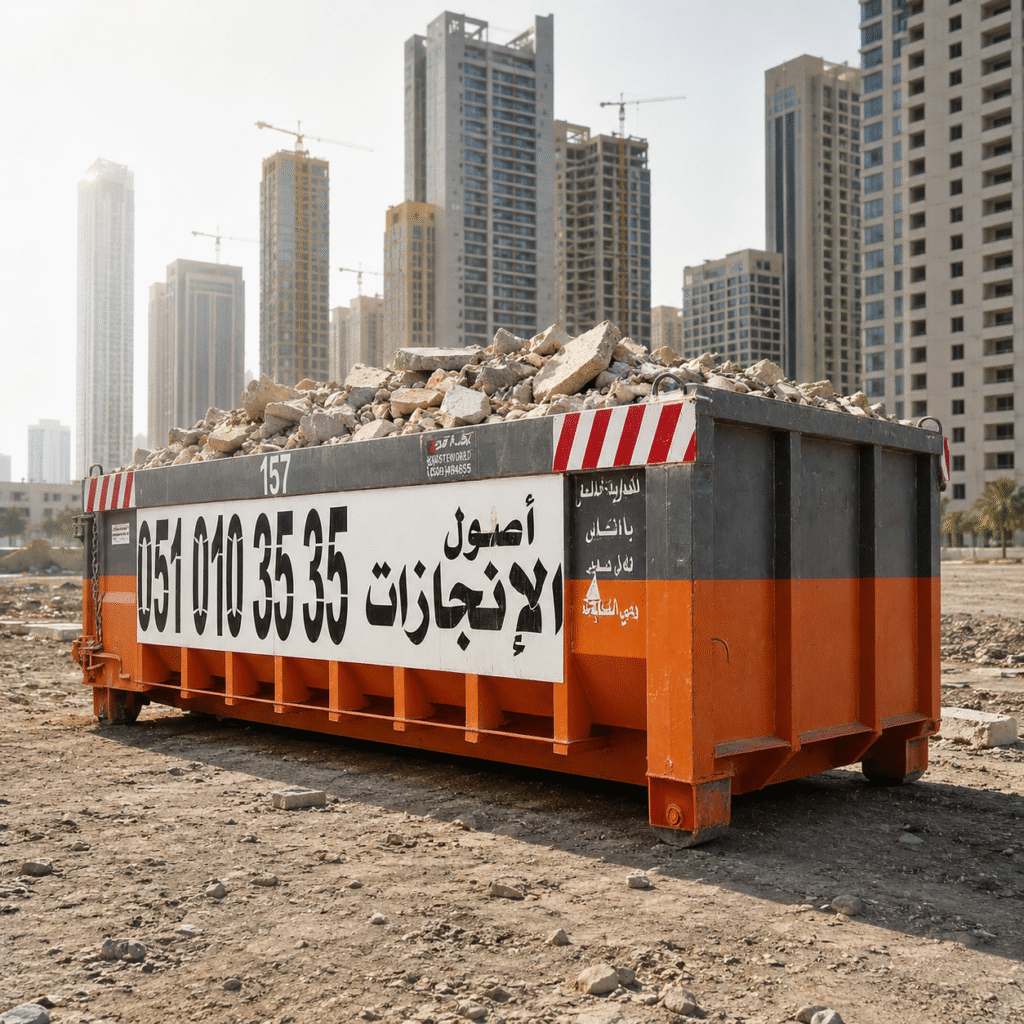
Construction container rental in Riyadh: the complete guide
Everything contractors, developers, and homeowners need to know about renting a construction waste container in the Saudi capital — sizes, costs, compliance, and how to choose the right provider.
In this article
- What construction container rental means in Riyadh
- Container sizes available and which projects they suit
- What goes into a construction container — and what doesn’t
- Cost structure: what you’re paying for and how pricing works
- Compliance: what Riyadh regulations require
- District-by-district access notes across Riyadh
- How to choose a provider — the non-negotiables
- Rental checklist before you book
- Frequently asked questions
Riyadh is one of the most active construction markets in the Middle East. From large-scale infrastructure projects along the Riyadh Metro corridor to villa renovations in Al Malqa and commercial fit-outs near King Fahd Road, the Saudi capital generates millions of tonnes of construction and demolition waste every year. Behind every one of these projects — small or large — sits the same practical question: how do you get a compliant, correctly sized waste container on-site, on time, and at a price that makes sense?
This guide covers everything that matters about construction container rental in Riyadh: the sizes available, what they cost, what the regulations require, how access conditions vary across the city’s districts, and what separates a compliant provider from one that creates liability for the project owner.
“The right container, from the right provider, booked with the right information — this is not a procurement afterthought. It is a project management decision that affects cost, compliance, and timeline from day one.”
Container sizes available and which projects they suit
Construction waste containers in Riyadh are available in a range of sizes, typically described in cubic metres. Choosing the correct size is important: too small results in overflow charges and project delays; too large means paying for empty space. The guide below covers the most commonly available sizes and their typical use cases.
Mini skip
2–4 m³
Small residential
Single bathroom strip-out, garden clearance, minor kitchen works. Fits in a standard parking space.
Midi skip
6–8 m³
Mid-size residential
Full kitchen or bathroom renovation, single room demolition, apartment partial fit-out.
Builder’s skip
10–14 m³
Multi-room / villa works
Multi-room renovation, villa floor replacement, commercial office strip-out up to ~200 m².
Large skip
16–20 m³
Major residential / light commercial
Full villa renovation, mid-size commercial fit-out, post-demolition clearance of a single floor.
Roll-on / Roll-off
20–40 m³
Large construction sites
Full villa demolition, large commercial projects, infrastructure works, multi-floor clearances.
Open-top hook-lift
10–30 m³
Flexible / high-volume
Sites needing frequent swap-out; hook-lift system allows container exchange without disrupting site operations.
What goes into a construction container — and what doesn’t
Not everything generated on a construction site belongs in a standard construction skip. Understanding the permitted and prohibited contents prevents the costly outcome of a mixed load being reclassified as hazardous waste — which dramatically increases disposal fees and creates regulatory exposure.
Accepted in standard construction containers
- Concrete, bricks, blocks, and masonry rubble
- Tiles, ceramics, and glass (clean, not mixed with hazardous material)
- Plasterboard and gypsum waste (check with provider — some segregate these)
- Timber offcuts and wood waste (untreated or unpainted preferred)
- Metal offcuts and scrap (ideally segregated for recycling value)
- Sand, soil, and excavation material (uncontaminated)
- General site packaging and non-hazardous rubbish
Not accepted — must be handled separately
- Paint tins, solvents, adhesives, and chemical waste (hazardous — requires Mwan-licensed hazardous waste contractor)
- Asbestos-containing materials (requires specialist removal and disposal)
- Contaminated soil with hydrocarbon or chemical residues
- Electrical components and e-waste
- Clinical or medical waste of any kind
- Tyres and automotive fluids
- Liquid waste of any kind
If prohibited materials are mixed into a standard construction container and identified at the disposal facility, the entire load may be reclassified as hazardous waste — triggering dramatically higher disposal fees and potential regulatory action against the project owner. Segregation is not optional.
What projects typically use construction container rental in Riyadh
Villa renovation
The most common use case in Riyadh’s residential districts. Full or partial villa refurbishments generate 10–40 m³ of mixed inert debris.
Recommended: builder’s skip to roll-off (10–30 m³)
Commercial fit-out
Office strip-outs, retail fit-outs, and F&B refurbishments along King Fahd Road, Al Olaya, and Riyadh’s business corridors.
Recommended: builder’s to large skip (10–20 m³)
Full demolition
Post-demolition site clearances require the highest container volumes and most frequent collection rotations of any project type.
Recommended: roll-on/roll-off with rotation schedule
Bathroom / kitchen works
Single wet room refurbishments are the most common small residential container rental in Riyadh’s villa neighbourhoods.
Recommended: mini to midi skip (2–8 m³)
Infrastructure works
Road repairs, utility installations, and civil works across Riyadh’s expanding northern and western development corridors.
Recommended: multiple roll-off containers with planned rotation
Landscaping & garden clearance
Green waste, topsoil, and hardscaping debris from Riyadh’s residential villa gardens — often combined with minor construction waste.
Recommended: mini to midi skip (2–6 m³)
Cost structure: what you’re paying for and how pricing works
Construction container rental pricing in Riyadh is rarely a single flat fee. Understanding the components of a quote prevents billing surprises after collection.
| Cost component | What it covers | Notes |
|---|---|---|
| Container hire fee | Daily or weekly rate for the container sitting on-site | Most providers quote a base period (3–7 days); extended hire charged daily beyond that |
| Delivery and collection | The truck journey to drop off and pick up the container | Some providers bundle this; others charge separately per trip |
| Disposal fee | The cost of processing and disposing of the waste at a licensed facility | Typically charged per tonne or per load; varies significantly by waste type |
| Overfill surcharge | Applied when material is loaded above the container’s stated fill level | Can be significant — confirm the fill-level mark and overfill rate before booking |
| Excess weight charge | Triggered when the loaded container exceeds the stated maximum tonnage | Dense inert materials (concrete, rubble) fill weight limits faster than mixed loads |
| Permit fee | Municipal permit for placement on a public road, if applicable | Applies to any container placed outside private property; some providers include this |
| Hazardous reclassification | Applied if prohibited materials are found in the container at collection | Can increase the total disposal cost substantially — prevention is the only solution |
Compliance: what Riyadh regulations require
Renting a construction container in Riyadh is not purely a commercial transaction — it sits within a regulatory framework that places obligations on both the waste provider and the project owner.
- Mwan licence: the waste contractor must hold a valid National Centre for Waste Management (Mwan) licence covering construction and demolition waste collection. Verify this before signing any agreement.
- Municipal placement permit: any container placed on a public road, pavement, or shared access area outside private property requires a permit submitted through the Balady platform or Amanat Al-Riyadh’s e-services. Many providers handle this on your behalf — confirm explicitly.
- Disposal documentation: a waste transfer note or disposal certificate must be issued by the provider upon collection, documenting where the waste was taken. Retain these records for a minimum of five years.
- Waste type restrictions: standard construction containers are not licensed for hazardous waste streams. Any project generating paint, solvents, or chemical waste must arrange separate, licensed hazardous waste collection.
District-by-district access notes across Riyadh
Al Malqa & Hittin
Good access, established coverage, newer roads. Compound gates may require advance security coordination.
Al Yasmin & Al Nakheel
Established districts, some narrow secondary streets. Confirm truck width against lane width before booking.
Al Sahafa & Izdihar
Mixed street widths across the district. Older sections have tighter access than newer developments.
Al Olaya & King Fahd Road
Commercial core; parking and access restrictions are higher. Coordinate with building management for delivery windows.
Diplomatic Quarter
Strictest access controls in Riyadh. All delivery vehicles require pre-clearance; same-day delivery is not reliable.
Al Qirawan & Al Arid
Active construction zone; surrounding road works can create access delays. Build extra delivery buffer.
Al Shifa & Al Diriyah
Southern districts; providers with northern depot positions may charge additional distance fees.
KAFD & Metro corridor
Major commercial development zone; coordinate container placement with site compound access management.
How to choose a provider — the non-negotiables
Riyadh’s construction container rental market includes providers ranging from fully licensed, professionally operated companies to informal operators with minimal compliance posture. The following criteria are non-negotiable when evaluating any provider:
- Valid, current Mwan licence — number provided and verifiable through official channels
- Named disposal facility — provider can state where your waste goes after collection
- Written quote with itemised fee breakdown — no verbal-only pricing for any component
- Disposal certificate issued upon collection — standard practice for any compliant operator
- Liability insurance — confirmed and available as a certificate on request
- Municipal permit handling — provider either submits the placement permit on your behalf or clearly advises when you must do so
- Segregation options — provider offers separate collection for key waste streams where your project generates them
Rental checklist before you book
Pre-booking checklist — construction container rental in Riyadh
Estimate debris volume in cubic metres and select the next size up
Confirm provider’s Mwan licence number and verify it is current
Ask where the waste goes — get the disposal facility named in writing
Get a written, itemised quote — hire, delivery, disposal, overfill, and weight conditions all stated
Confirm who handles the Balady / Amanat Al-Riyadh placement permit if the container is on a public road
Confirm provider carries liability insurance
Check site access: road width vs. truck dimensions, compound gate clearance, security pre-notification
Identify any hazardous waste streams (paint, solvents, chemicals) and arrange separate collection
Confirm disposal certificate will be issued and in what form
Plan segregation zones on-site before the container arrives
Frequently asked questions
How long does a construction container rental typically last in Riyadh?
Most providers offer a base rental period of three to seven days, after which extended hire is charged on a daily basis. For longer renovation projects, many operators offer weekly or fortnightly rates with pre-scheduled collection and swap-out arrangements. The key is to match the rental period to actual project duration rather than booking the shortest available option and extending repeatedly — consecutive extensions are typically more expensive per day than a single longer-term booking.
Can I put soil and excavation material in a standard construction skip in Riyadh?
Clean, uncontaminated soil and excavation material can generally go in a standard construction container, but always confirm with the specific provider — some have separate pricing for soil loads because of the weight density. Contaminated soil with hydrocarbon residues, chemical contamination, or construction chemical leaching is classified as hazardous waste and must be handled separately through a Mwan-licensed hazardous waste contractor.
What is the difference between a skip and a roll-on/roll-off container in Riyadh?
A skip (mini to large, typically 2–20 m³) is delivered and collected by a skip-loader truck using a hook-arm or chain mechanism and is suitable for most residential and mid-size commercial projects. A roll-on/roll-off (RoRo) container (typically 20–40 m³) is a larger, open-top box delivered and collected by a dedicated vehicle and suited to large construction sites with significant and sustained waste generation. RoRo containers require more space and better site access than skips and are not typically suitable for residential streets in Riyadh’s villa districts.
Do I need to be on-site when the container is delivered or collected?
For delivery: yes, ideally. The driver needs to confirm placement location and will not always be able to make a judgement call on behalf of an absent site contact — an unmanned site can result in the container being placed incorrectly or the delivery being aborted. For collection: a site contact is less critical, but someone should be available to confirm the container is ready for collection and to receive the waste transfer documentation.